


FTMO has launched futures. FTMO gave us a Growth 50K account on the morning it went live, we worked through both plans properly, and this is our read on what you get for the money.
That free account is worth saying in the first line rather than the last. It buys FTMO a look from the inside and nothing else. The verdict below, the two figures we could not get it to document, and the criticisms in "A few honest caveats" are all ours.
We opened the announcement expecting very little. A launch post in this corner of the industry is usually a rules page with a new logo on it. This one is not, and the reason is unglamorous. FTMO has spent years building a reputation on paying people when it says it will, and it has now put that behind a futures product whose terms are, in a couple of places, better than we expected.
What follows is both plans, all three sizes, the numbers that actually decide anything, what buying it looked like from our side, and who each plan suits. The trade-offs are flagged too, because there are some.
What launched
FTMO Futures is its own product line. Its own plans, its own account sizes, its own rule set, its own section of the dashboard, its own platform access. Nothing carries over from the CFD business next door, and you sign up for it on its own terms. That is why it is a separate listing on this site, scored against other futures firms rather than against the CFD business it shares a name with.
The whole line went live at once rather than as a pilot. Two plans, three sizes each, a monthly subscription, no activation fee, platform included. What you trade is exchange listed futures, and the rules you are measured against are applied to exchange prices.
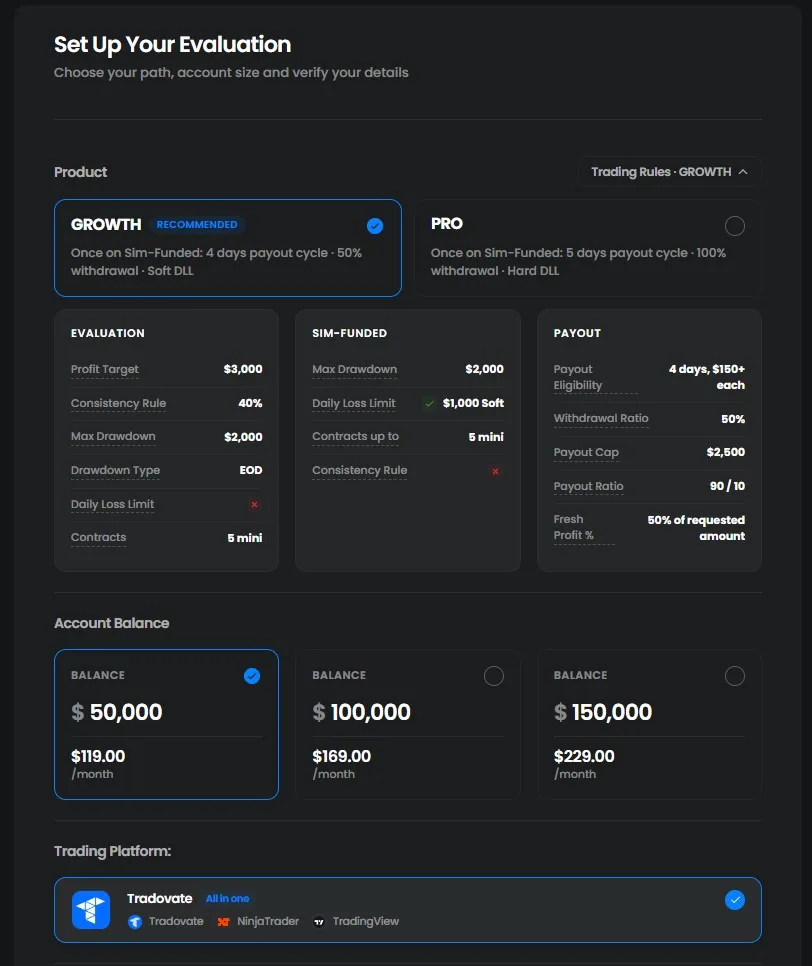
Putting the whole rulebook on the page you pay from is not standard practice in this industry and it should be. You are not hunting through a separate PDF to find out what you just agreed to.
Simulated accounts, real rewards
This matters and a lot of coverage skates over it.
FTMO's model runs on simulated trading. You trade a demo account that mirrors real market conditions, following risk rules built to test whether you can manage exposure and stay consistent. Pass the evaluation and you move to a sim-funded account, which is still simulated, and performance there earns real money under a written agreement.
So where this review says funded, read sim-funded. FTMO's own dashboard uses that language, and the agreements section is labelled sim-funded rather than funded. The rewards are real. The trading environment is a simulation. Both of those are true at once, and it is worth checking that whoever you sign up with says so as plainly.
What you are buying, then, is a structured test of your risk management plus a reward agreement if you pass it and keep performing. That framing is useful, because it tells you what to optimise for. Surviving the rules, not hitting a number in a hurry.
Futures in two minutes
Skip this if you already trade them. If you are arriving from CFDs, it is worth two minutes, because the instrument explains every rule below.
A futures contract is a standardised agreement, traded on an exchange, to buy or sell a set quantity of something at a set date. Standardised is the word that matters. The exchange writes the specification, not your broker. Contract size, the smallest increment the price can move, the hours it trades, the date it expires. Buy one E-mini S&P 500 contract and you are buying precisely what everyone else in that contract is buying, at a price formed in one public order book and cleared centrally.
Four things follow, and they all feed into how you should read an evaluation.
Size is fixed per contract. You do not pick a dollar amount, you pick how many contracts. One E-mini S&P moves $50 per index point, so its minimum tick of 0.25 points is $12.50. The Micro version is a tenth of that, $5 a point and $1.25 a tick. Sizing in futures means counting contracts.
The contract limit is your real position cap. Both plans express it in minis. Five on the 50K, ten on the 100K, fifteen on the 150K, and the dashboard spells out the conversion at ten micros to one mini, counted across every instrument you have open at once. Five E-mini S&P contracts is $250 per index point, which against $2,000 or $3,000 of drawdown allowance is a great deal of position. The limit is generous rather than restrictive, and staying well under it is on you.
Index futures trade almost around the clock on weekdays. Your exposure is not sitting unattended overnight waiting for a session you cannot reach. That is one reason end-of-day risk calculations work sensibly here.
Contracts expire. Index futures run quarterly, so a position held long enough has to be rolled into the next month. Plan for it rather than discovering it.
Leverage comes from margin. You post a fraction of the contract's notional value to hold the position, which is what makes a $50,000 account meaningful, and it is exactly why every credible futures account arrives with firm drawdown rules attached. The rules are not there to annoy you. They are there because the instrument moves.
Two plans, and they really are different
FTMO split the line rather than trying to make one rule set fit everybody. Pro targets experienced traders chasing efficiency from the account. Growth is aimed wider and uses familiar mechanics at a lower entry price. These are not the same account with two price tags.
Pro, room to breathe
The headline is the ratio between the profit target and the drawdown. On the 50K Pro you are asked to make $3,000 with $3,000 to work with. One to one. On the 100K it is $6,000 against $4,500, and on the 150K, $9,000 against $6,000.
If you have traded evaluations before you will know why that first number stands out. A 1 to 1 ratio means the account is not asking you to thread a needle. It gives a strategy room to be wrong for a stretch, which is most of what separates a survivable evaluation from a lottery ticket.
Drawdown trails at end of day rather than intraday. Your level comes off your closing balance, so an open trade that goes against you mid-session and recovers does not move the level against you. On Pro the trailing also locks at the starting balance. Once it has climbed back to where you began it stops there instead of following your equity up forever, which is the difference between a buffer you can build and a target that chases you.
Pro does carry a hard daily loss limit. A thousand dollars on the 50K, $1,500 on the 100K, $2,000 on the 150K, in both phases. Hard means what you think it means. There is also a 50% consistency requirement during the evaluation, which drops away once you are sim-funded.
Contracts scale with size at 5, 10 and 15, and you may hold up to three accounts at once.
Growth, the accessible entry
Growth is where most people reading this will start, and the design logic gets clear once you look at the two rule changes.
First, there is no daily loss limit during the evaluation. None at all. You have a maximum drawdown to respect, $2,000 on the 50K, and inside that you manage your own daily risk. If your strategy occasionally needs to take a bigger single-session swing, that removes the rule that most often ends an evaluation for reasons unrelated to skill.
Second, the daily loss limit on the sim-funded account is soft. Hit $1,000 in a day on the 50K and trading locks for the rest of the session. The account lives and you come back tomorrow. A limit that interrupts the day is worth a great deal more than one that puts the whole run at risk.
The trade-off is the ratio. Growth 50K asks for $3,000 against $2,000, so 1.5 to 1. The 100K is 1.7 to 1 and the 150K 1.8 to 1. You are paying for the lower price and the softer limits with a tighter ratio, and that seems fair. It is stated plainly rather than buried, which matters more.
Growth runs a 40% consistency rule during the evaluation and none once you are sim-funded. Same contract scaling, same three accounts.
Neither plan has a minimum trading day requirement. Take the time you need, or do not.
Pricing
Monthly subscription on both, no activation fee on either.
| Account size | Growth monthly | Growth reset | Pro monthly | Pro reset |
|---|---|---|---|---|
| $50,000 | $119 | $109 | $139 | $129 |
| $100,000 | $169 | $159 | $199 | $189 |
| $150,000 | $229 | $219 | $269 | $259 |
The $20 gap between Growth 50K and Pro 50K is the bit worth chewing on. Twenty dollars a month moves you from 1.5 to 1 down to 1 to 1, from a 50% withdrawal ratio to 100%, and from a $2,500 payout cap to $5,000. You give up the soft daily limit and take a hard one instead.
So the two are priced against different needs rather than against each other. If you can trade inside a hard daily limit, that extra twenty buys the better ratio and the full withdrawal. If your strategy needs the room a soft limit gives, Growth is your account and the lower price is a bonus rather than a compromise.
One thing the price table does not show, and it is the single most important number in the product. This is a subscription, so patience has a price here that it does not have on a one-off fee. Taking four months over a Pro 150K evaluation is $1,076 before you have been paid anything. Budget it as a monthly cost with an end date you actually commit to, not as an open-ended option, and run the arithmetic before you subscribe rather than after.
Payouts in plain numbers
On Pro a payout window opens every 5 days, and to request one you need at least 5 qualifying days, meaning days with profit of $200 or more each on the 50K, $300 or more on the 100K and $500 or more on the 150K. Withdrawals are 100% and the split is 90/10 in your favour. Caps are $5,000, $6,000 and $8,000.
On Growth the window opens every 4 days, with a per-day profit threshold of $150 or more on the 50K. The withdrawal ratio is 50%, the split is also 90/10, and caps are $2,500, $3,000 and $4,000.
A day you traded flat does not count toward either. The threshold is a profit floor, not an activity requirement, which is a meaningful difference if your strategy trades rarely.
One mechanic applies to both and deserves reading twice. In each payout cycle, at least 50% of what you request has to be new profit generated in that cycle. In practice you cannot bank one large gain and then draw it down in slices across a dozen cycles. The account has to keep working. It is a sensible rule for a firm whose business depends on not paying out against stale performance, and it is the kind of detail worth knowing beforehand.
We have not taken a payout on this account yet, so the above is the mechanics rather than our experience of them. We will come back and update this once we have been through a cycle. Verified payout proofs from traders are collected separately and are not part of this review.
What the sign-up looks like
Ours is the Growth 50K. Checkout is one page. Pick the plan, pick the balance, confirm the platform, agree to the terms, place the order. The rules for whichever plan you have selected sit on the same page in three columns covering evaluation, sim-funded and payout.
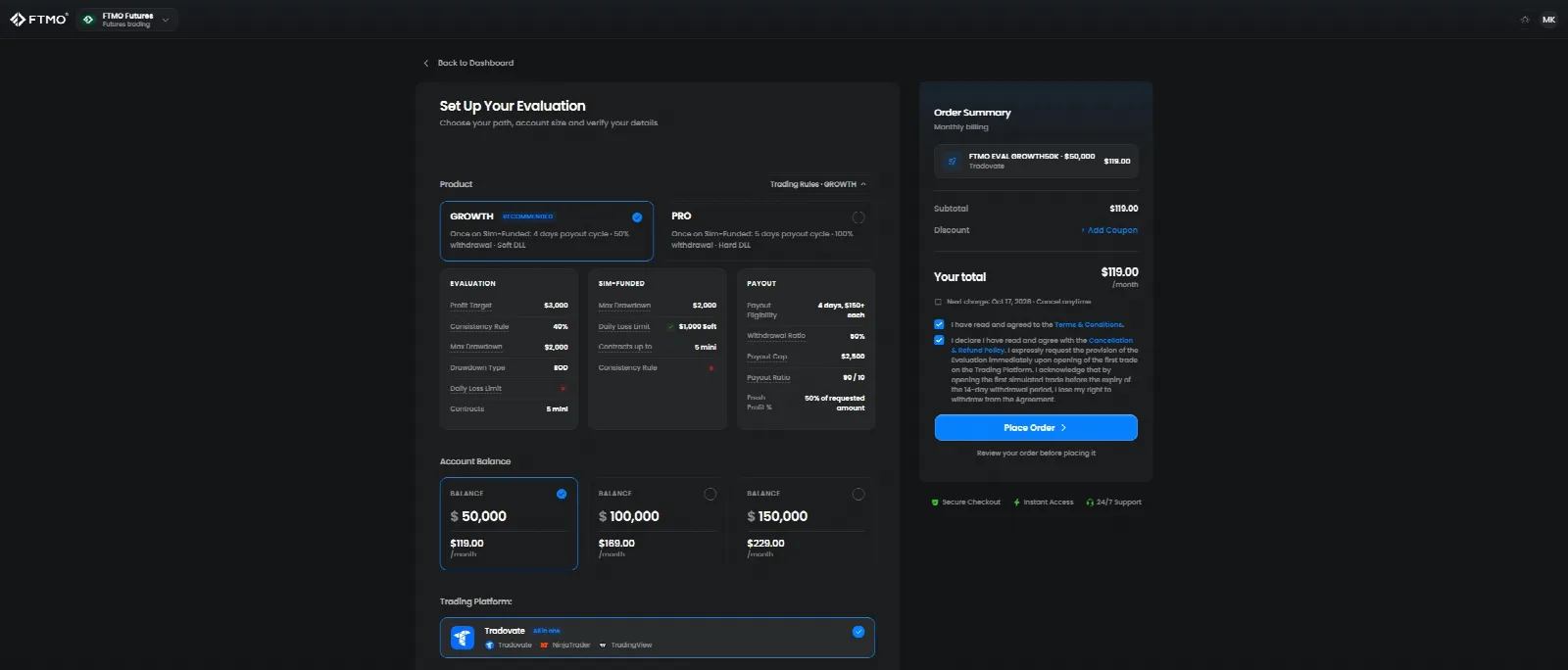
Two things are worth knowing before you get there.
The checkout carries an explicit declaration that by opening your first simulated trade before the 14-day withdrawal period expires, you waive your right to withdraw from the agreement. It is disclosed plainly on the page rather than buried, which is how it should be, but read it instead of clicking past it.
Platform access is Tradovate, bundled with NinjaTrader and TradingView. If your setup already lives on TradingView, nobody is asking you to relearn anything.
The account then appears on the dashboard with credentials, a balance, a phase label and a link to the trading dashboard. Ours also states the date the next payment comes out, 17 October, which we appreciated more than expected. Knowing exactly when a subscription renews is the sort of thing you should not have to dig for.
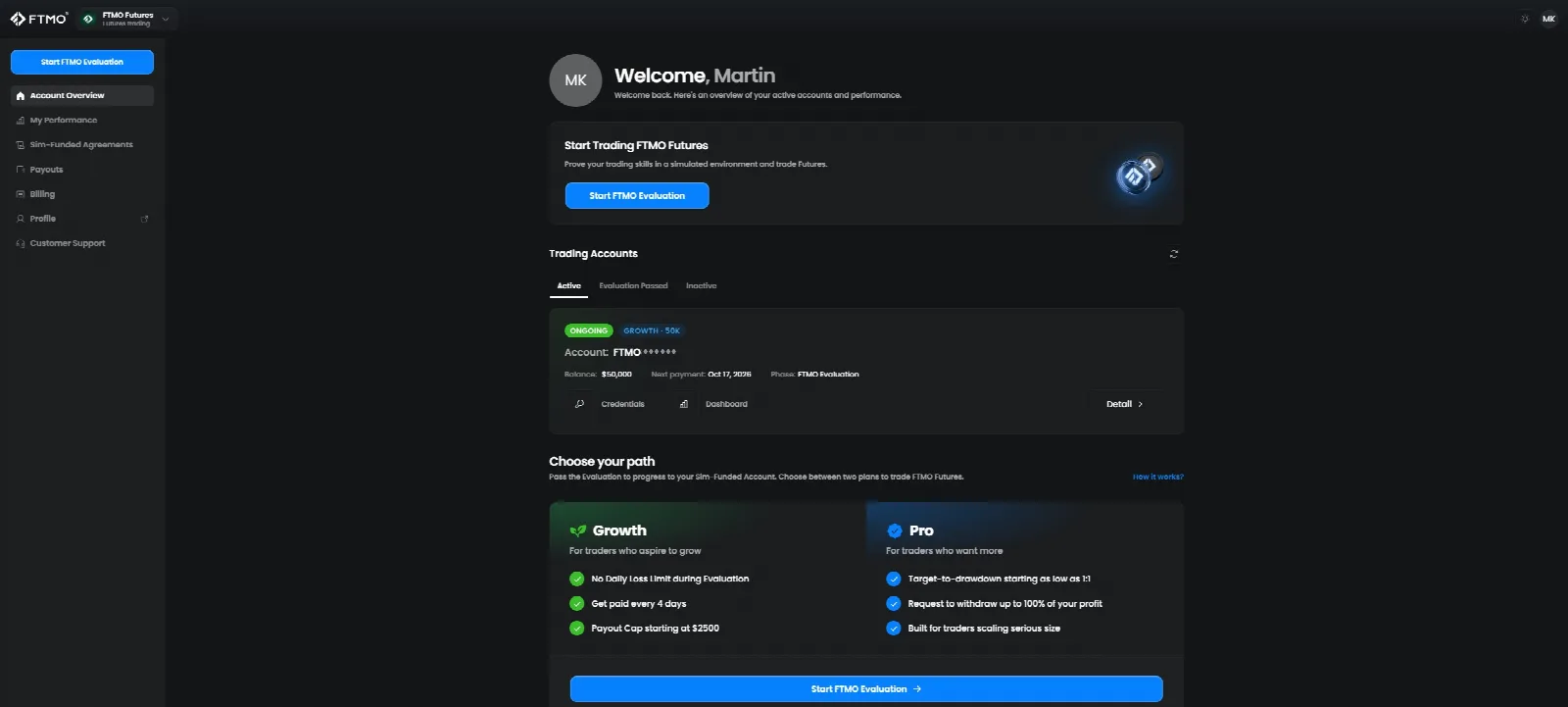
What the dashboard tracks
This is the part most reviews do not show you, and it is where the rules stop being text and start being numbers with your money attached.
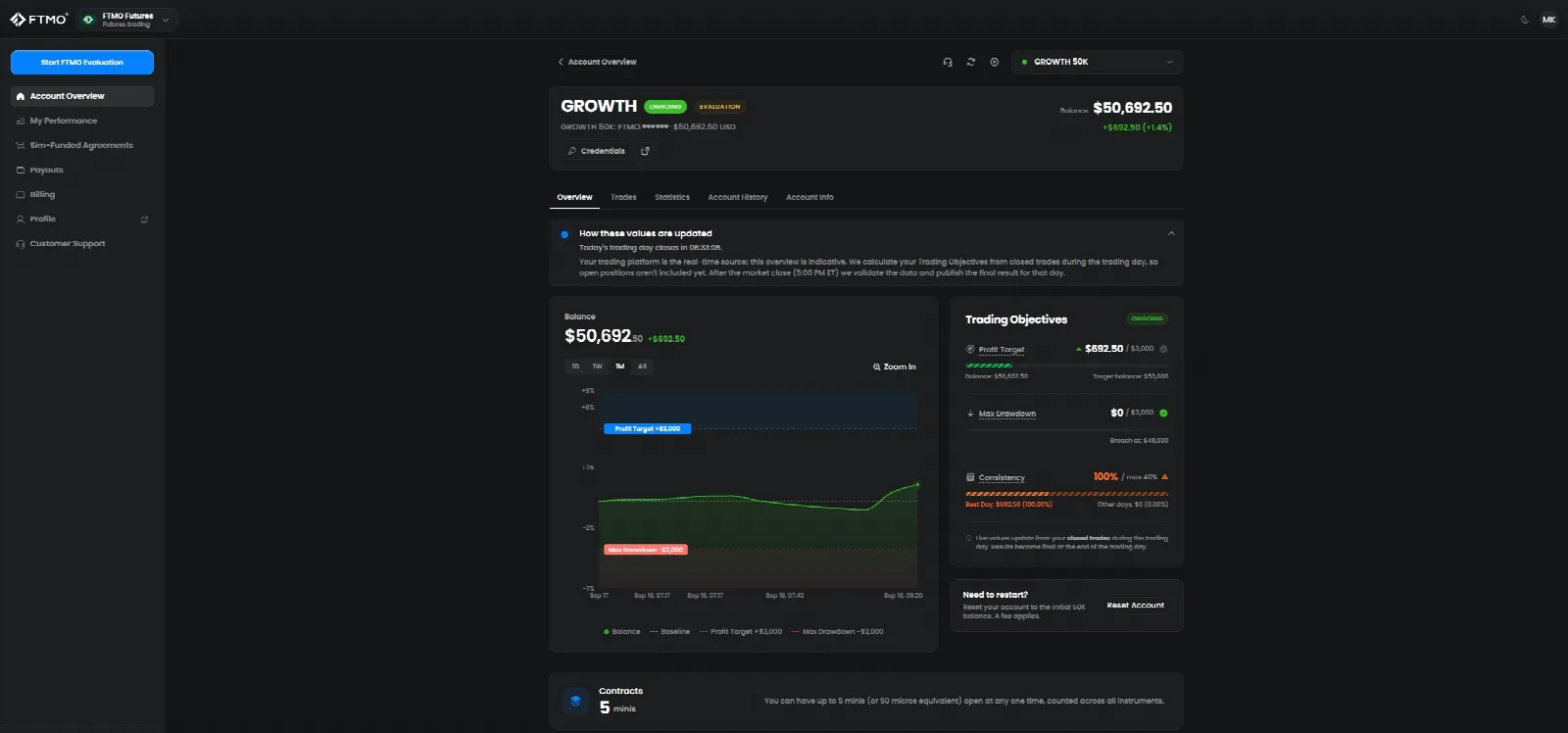
That is the account a day in, up $692.50, so roughly 23% of the way to the $3,000 target. Three things on that screen are worth pointing out.
The breach level is stated in dollars. Max drawdown reads $0 of $2,000, and underneath it, "Breach at: $48,000". No mental arithmetic and no working out where the line currently sits. It is a small thing and it removes an entire category of expensive mistake.
The consistency rule is shown as a live calculation. It reads 100% against a 40% maximum, with a warning triangle, and underneath, "Best Day: $692.50 (100.00%)" and "Other days: $0 (0.00%)". So the rule is measured as your single best day divided by your total profit, which confirms in numbers what most firms will only describe in words.
It also explains something that would otherwise be alarming. One profitable day into an evaluation, your best day is by definition 100% of your profit, so the figure starts at its worst possible reading and improves as trading days accumulate. It is arithmetic rather than a problem. Worth knowing before you see a red warning on day one and assume you have broken something.
Objectives are calculated from closed trades. The panel says so directly. Open positions are not counted yet, the platform is the real-time source, and after the market close at 5:00 PM ET the day's data is validated and published as final. That is the end-of-day mechanic in plain language rather than buried in a rules PDF, and it is consistent with the end-of-day trailing on both plans.
There is also a Reset Account button on the same page with the fee attached, which we would rather see than have hidden behind a support ticket.
Who should pick what
An experienced futures trader with a strategy that respects a daily stop should take Pro at the 50K. The 1 to 1 ratio and the 100% withdrawals are the most efficient terms in the line, and a hard daily limit is not what will stop you.
A strategy that needs latitude inside a session, or a trader who wants the lower monthly cost while working out whether this format suits them, should take Growth. No evaluation daily loss limit plus a soft limit once sim-funded means the rules are much less likely to end a run over one session. Accept the tighter ratio in exchange.
Anyone new to futures should take Growth 50K and treat the first month as tuition. Not as an investment, and not as a shortcut.
A few honest caveats
The consistency rule deserves attention on both plans. Capped at 40% on Growth and 50% on Pro during the evaluation, it changes how you should size and pace, and it catches people who make their target in two excellent sessions. If your edge concentrates around data releases, around the open, or around a handful of setups a month, read that clause as a product decision rather than a footnote. It is the one term here we would call genuinely restrictive, and Growth's 40% is tighter than much of the futures field.
Maximum drawdown is what ends accounts, not the profit target. On Growth 50K you have $2,000. End-of-day trailing is friendlier than intraday, but it still trails.
And the obvious one. A subscription is a recurring cost that keeps going whether or not the month went well. Price it into your plan honestly, and cancel it if the format turns out not to suit you. There is no shame in that and no penalty for it.
What we could not confirm
Two things are recorded here as undocumented rather than guessed, because a number invented to fill a gap is worse than an admitted gap.
Whether the Growth trailing drawdown locks. FTMO documents the lock on Pro, where the trailing level stops permanently once it reaches your starting balance. The Growth rule set does not state it either way. That distinction decides a lot of accounts, so we have asked rather than assumed.
The Growth qualifying-day thresholds above the 50K. The $150 floor on the 50K is published. The equivalent figures on the 100K and 150K are not.
Both are with FTMO. This section gets edited when they answer, and the date on the page moves with it.
The verdict
What makes this launch interesting is not any single rule. It is a firm with an established payout record entering futures with terms that hold up on their own merits, independently of the brand behind them.
Pro's 1 to 1 at the 50K with 100% withdrawals is a strong offer by any measure. Growth's evaluation with no daily loss limit, and the soft limit in the sim-funded phase, address the rule that ends most evaluations for reasons that have nothing to do with skill. Both are priced where a serious trader can justify the subscription, and neither charges an activation fee.
The reservations are real but narrow. The 40% best-day cap on Growth will exclude some perfectly good traders, the qualifying-day thresholds reward frequency over quality, and the subscription quietly penalises the patient. None of that is disqualifying and all of it is worth knowing before the first invoice.
Trading futures is hard and no rule set changes that. What a good rule set does is make sure that when you fail, you fail because of your trading and not because of a technicality. Measured that way, this is a strong entry. Compare it against the rest of the futures field before you subscribe, and read the four drawdown structures if you are not yet sure which one you are being sold.
Full rule tables
Every figure in this review, in one place. Recorded from FTMO's own pages and our account on 18 September 2026.
| Pro plan | $50k | $100k | $150k |
|---|---|---|---|
| Monthly subscription | $139 | $199 | $269 |
| Reset fee | $129 | $189 | $259 |
| Activation fee | None | None | None |
| Profit target | $3,000 | $6,000 | $9,000 |
| Max drawdown | $3,000 | $4,500 | $6,000 |
| Target to drawdown | 1 : 1 | 1.33 : 1 | 1.5 : 1 |
| Drawdown type | EOD trailing | EOD trailing | EOD trailing |
| Trailing lock | At starting balance | At starting balance | At starting balance |
| Daily loss limit, evaluation | $1,000 hard | $1,500 hard | $2,000 hard |
| Daily loss limit, sim-funded | $1,000 hard | $1,500 hard | $2,000 hard |
| Consistency rule, evaluation | 50% | 50% | 50% |
| Consistency rule, sim-funded | None | None | None |
| Minimum trading days | None | None | None |
| Max contracts | 5 mini | 10 mini | 15 mini |
| Max concurrent accounts | 3 | 3 | 3 |
| Payout frequency | Every 5 days | Every 5 days | Every 5 days |
| Payout eligibility | 5 days at $200+ | 5 days at $300+ | 5 days at $500+ |
| Withdrawal ratio | 100% | 100% | 100% |
| Payout cap | $5,000 | $6,000 | $8,000 |
| Profit split | 90 / 10 | 90 / 10 | 90 / 10 |
| New profit per request | 50% of request | 50% of request | 50% of request |
| Growth plan | $50k | $100k | $150k |
|---|---|---|---|
| Monthly subscription | $119 | $169 | $229 |
| Reset fee | $109 | $159 | $219 |
| Activation fee | None | None | None |
| Profit target | $3,000 | $6,000 | $9,000 |
| Max drawdown | $2,000 | $3,500 | $5,000 |
| Target to drawdown | 1.5 : 1 | 1.7 : 1 | 1.8 : 1 |
| Drawdown type | EOD trailing | EOD trailing | EOD trailing |
| Trailing lock | Not documented | Not documented | Not documented |
| Daily loss limit, evaluation | None | None | None |
| Daily loss limit, sim-funded | $1,000 soft | $2,000 soft | $3,000 soft |
| Consistency rule, evaluation | 40% | 40% | 40% |
| Consistency rule, sim-funded | None | None | None |
| Minimum trading days | None | None | None |
| Max contracts | 5 mini | 10 mini | 15 mini |
| Max concurrent accounts | 3 | 3 | 3 |
| Payout frequency | Every 4 days | Every 4 days | Every 4 days |
| Payout eligibility | 4 days at $150+ | 4 days, threshold not documented | 4 days, threshold not documented |
| Withdrawal ratio | 50% | 50% | 50% |
| Payout cap | $2,500 | $3,000 | $4,000 |
| Profit split | 90 / 10 | 90 / 10 | 90 / 10 |
| New profit per request | 50% of request | 50% of request | 50% of request |
Trading futures involves substantial risk of loss and is not suitable for every investor. Every account described here operates in a simulated environment, and simulated results do not guarantee future performance. Subscription fees are payable regardless of trading performance. Nothing on this page is investment advice. How we reach a verdict is set out in our review policy, and how the score on this page is calculated is set out in the methodology.